
A Mistaken Haert

“Vale la pena che un bambino impari piangendo quello che può imparare ridendo?”
Gianni Rodari
A pupil and his teacher learn an important lesson: a grammatical mistake can cause great misunderstanding, but even a correction done the wrong way can cause useless fears.
Background design and fabrication
For the staging, we decided to create sets that had a slightly expressionist tendency. The elements created a distortion that was progressively more evident throughout the video, to make the settings more visually appealing. We have made four sets: the classroom, the corridor, the street and the shop. The objects in the various sceneries were created using different materials.
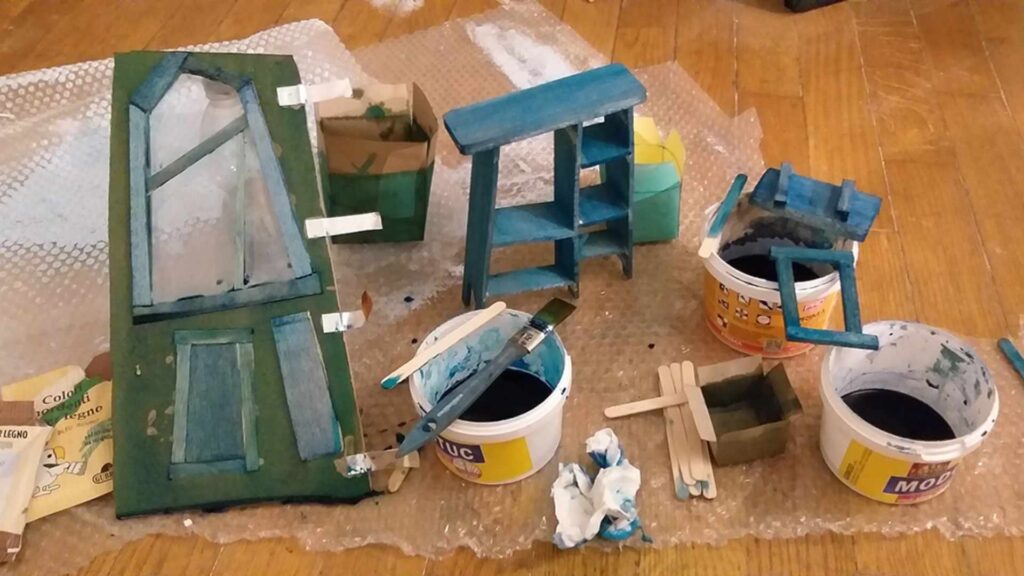
For the classroom we made some research regarding how the class were in the sixties. For the props we used some balsa wood and plywood, and for the wall we used Medium-density fibreboard (MDF) usually used to make indoor furniture. The props were coloured using mordant colors for woods that keep the veins of the material. For the walls of the set, we previously put some putty on and we coloured them with acrylic wall color. When you have to craft so many elements sometimes you have to think in s creative way to build specific items, for example for the parquet we used 528 tongue depressors (an object used typically by doctor). Another difficult part was to keep the puppets and the elements of the set proportionate. For example, we had to adjust the door of the classroom because at the beginning it was too high.
Note
We personalised the set with five little frames. You can find Gianni Rodari’s portrait, Martino’s class group photo, teacher Grammaticus’s portrait, and portraits of our thesis supervisor and the coordinator of the Illustration and Animation course.
The Classroom


The corridor
For the corridor we used the same material as for the classroom because in the video we can see both the class and the corridor, so we had to keep a continuity between the two sets. The corridor is the second biggest set we created for the video, it’s 130 cm long and 45 cm wide.
Note
Martino goes to class 3°A.


The street
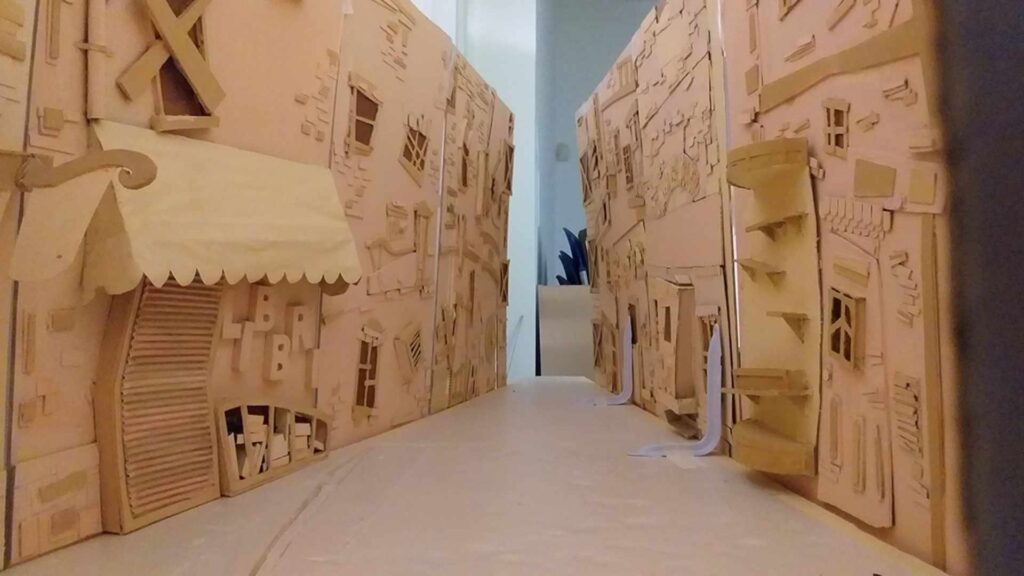
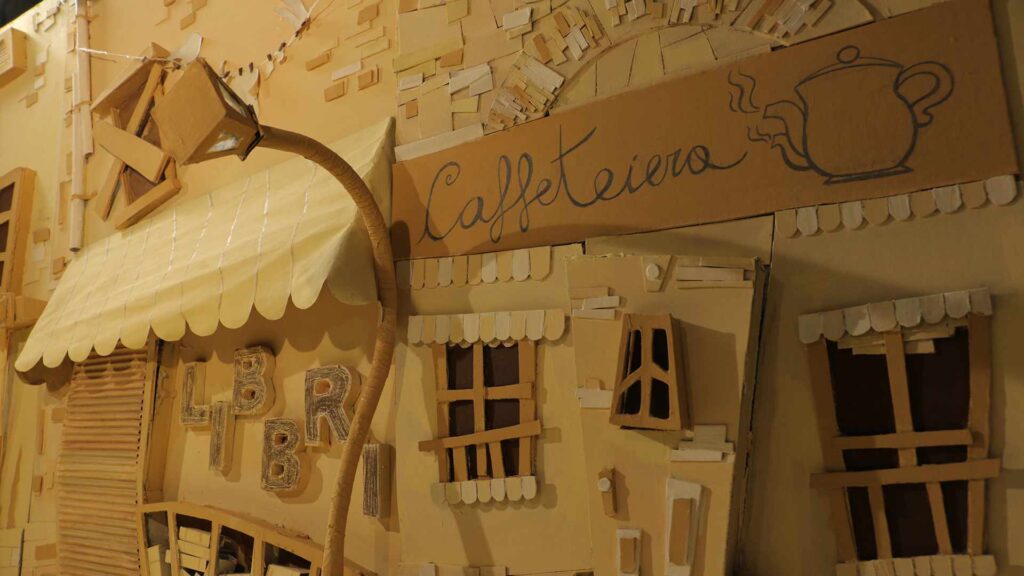
The biggest set we created was the street, that is 210 cm long. The set is wider near the shop entrance and it goes shrinking in the opposite direction: this creates the visual illusion of a longer street. There are twelve palaces, six for both side. They are built into twelve separate pieces, thus simplifying the animation process. All the palaces have different dimension and different quantity of detail. For this set we didn’t choose a realistic atmosphere, but we decided to use monochromatic colours to recall the dictation written by Martino and the fact that he fell in his theme. Sometimes we needed to rethink of something we had previously crafted, for example we re-made the shoes shop’s window because the first one we had realised wasn’t functional for the purpose we had (and it was quite ugly).
So we reinvented a new one and we used it for the movie.
Note
To simulate the tarmac for the street we have used about 2,5kg of sand.
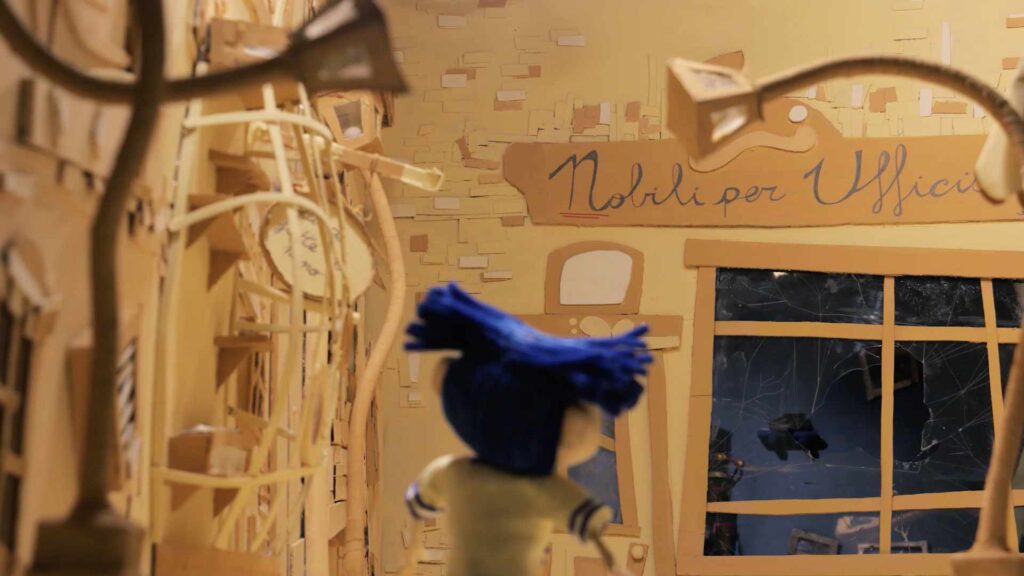


The shop
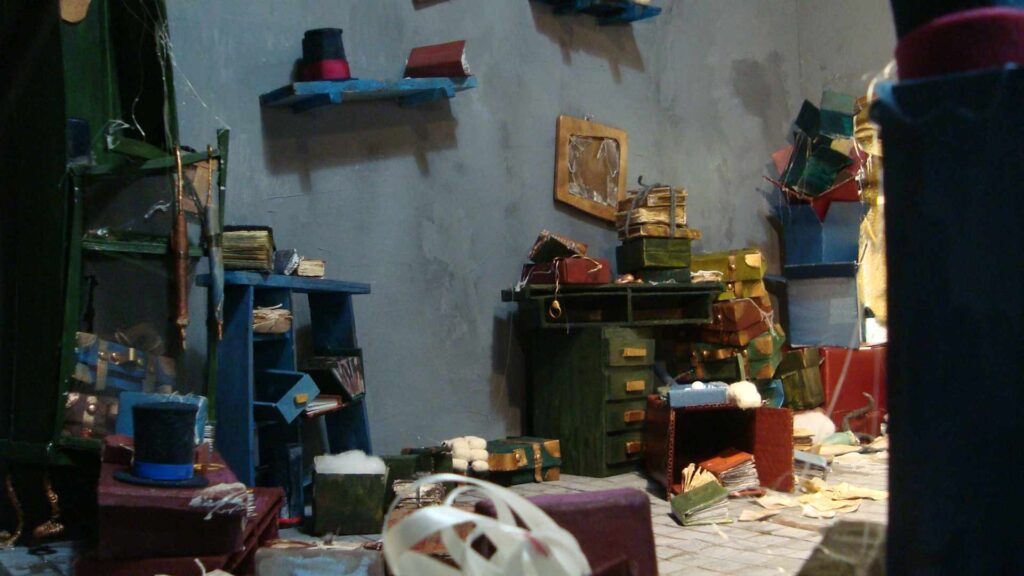
The shop was the most difficult set we had to create, because it needed to be full of different stuff like furniture, trunks, books etc… To build the floor we used some vegetable cardboard 1.8 mm thick and we had to cut each tile one by one. We coloured the tiles with acrylic colours and then to make them look old and dirty we added some water with brown acrylic. We paid particular attention to the colours of the different object in the shop: red, green, blue. We choose to keep a desaturated color for all the furniture because we wanted the puppets not to be confused with the set props.
Note
Most of the element in the shop are our first attempts of props for the class, for example desks and wardrobes that weren’t good enough to be used for the classroom. We added also the prototypes of the puppets. We thought that was a good idea because Martino’s errors live in the shop and so why not add ours “errors” too!?


Animatic & 2D animation
What were the challenges for the 2D?
Well, for this thesis we needed to face many challenges, and I think the part made in 2D was one of the most demanding, because after three months with only props crafting and stop motion animation I had to start again using Toonboom Harmony, and it wasn’t very easy. In 20 second of animations, we had to convey the evilness of the teacher as he tries to erase all the errors and even Martino. Furthermore it was very difficult to keep in each frame the proportion of the characters and harmonise the 2D animation with the stop motion, the main technique of the movie.
We decided to include 2D animation because it allowed us to show effectively the threat represented by, the evil teacher that want to erase all the errors. The 2D technique suited the need for quickness and clarity in the visuals that we were looking for.

